Sunday, March 27, 2011

How an Ethnocentric view does evoked conflicts

How an ethnocentric view does evoked conflicts between two cultures

The British sailed to Australia with the intention of colonizing the land and when they set foot in Australia and met the Aboriginals, they started to look at their ethnocentric view through their cultural lens. The view of the First Australians caused conflicts between these two different cultures due to the British thoughts of being superior to the Aboriginals. Through the Aboriginal’s own cultural eyes, they saw the British as different, reference to their clothing and questions such as ‘why are they coming here? And how long are they staying?’ Before the British came, the Aboriginals lived in diverse tribes all around Australia and they all lived in harmony due to their own cultural rules between each other as a tribal community. From the “First Australians” DVD, words said when the British first encountered the Aboriginals ranged from savages to animals that had no rights. Also the documentary mentioned that they thought it was abnormal how the Aboriginals lead their lifestyle, which included the less or no clothing used. The British believed their lifestyle is the lifestyle that everyone should follow and that it is the only right way to live, this means that their ethnocentricity empowered them to not understand or accept other lifestyles, such of the Aboriginals. Since the British were obviously more advanced in their technology and had more knowledge of the world, which made them think they should be more superior to the Aboriginals. They thought they had more skills and knowledge, which when compared them to the Aboriginal, made it seems like the Aboriginal were not smart or even have the capacity to learn. Evidence from both the allegory of ‘The Rabbits’ and the documentary, shows that the British judged on the colour of the Aboriginal’s skin as filthy in contrast to their own fair skin. Meanwhile when the colonizers came, the British governor, Arthur Phillip, decided upon a relationship with one of the Aboriginal, which happens to be Bennelong. Governor Phillip believed that he needed an insight to what the Aboriginal tribes are reacting to the British or ‘white’ settlers. The relationship between them created a temporary peace and maybe even made the two cultures bond, or so Governor Phillip thought. However even with Governor Phillip who made an effort with an Aboriginal, the other British people were still judgmental and still had the ethnocentricity to think of the Aboriginal people as savages and animals who were inferior. Even Governor Phillip had thought at first by creating a bond with one of the Aboriginal, it would release tension so that the British would then be able to take away more of their land. Eventually all these ethnocentric view and thoughts moved the British to think its okay to take away the Aboriginal lands and that they had no feelings or be able to fight back. Eventually more conflicts evoked due to the British started to not only think with an ethnocentric view, but act with it, meaning being superior against the ‘weak’ Aboriginals. The conflicts that was evoked further was due to the British or the ‘whites’ acted and killed some of the Aboriginal people. The Aboriginals then fought back and the British fought back in a continuous cycle. From the documentary, “First Australians”, it showed and described how after the first fight between two cultures, triggered more fights to occur; the British continued to fight with no mercy and began slaughtering more Aboriginal for reasons as to eliminate the population. This happened when Governor Phillip and Bennelong and his companion sailed to England. Back in Australia, the British who were not as considerate as Governor Philip were left in charge and so more wars began. Hungry for power and land, the British began to take full control, spreading slowly all over Australia by taking more and more of the Aboriginal land. They even destroyed the native crops and grew their own crops and sometimes took advantage of the Aboriginals and turned them into slaves working on the land. Enraged from the merciless act of killing, slavery and the taking of native lands, the Aboriginal formed a rebellion lead by Windradyne. Both culture played out violence against violence which creates endless torments and fights. The British were stubborn and refused to back down or respect the Aboriginal’s culture. Finally, even though the British thought they were more civilized, they were wrong, the Aboriginal leader, Windradyne was the one who was brave and saved his people from further killing by being civilized enough to make a peace treaty with the British butchers. Having an ethnocentric view does provoke conflicts between two different cultures. Both cultures were playing violence on violence which did in fact, from the evidence shows that the British butchers started it all due to their ethnocentric lens. The Aboriginals, in my view, were the victims although some of the British were in fact injured or killed as well, but this was only because the British acted first upon them and so it was considered a payback in their culture. If only the British would learned to accept a new culture rather than judging the Aboriginals through their ethnocentric lens, less conflicts would erupt.

Thursday, February 24, 2011

Julius Caesar Oral

Julius Caeser Oral Assesment


CASSIUS
Will you go see the order of the course?

BRUTUS
Not I.

CASSIUS
I pray you, do.

BRUTUS
I am not gamesome. I do lack some part
Of that quick spirit that is in Antony.
Let me not hinder, Cassius, your desires.
I’ll leave you.

CASSIUS
Brutus, I do observe you now of late
I have not from your eyes that gentleness
And show of love as I was wont to have.
You bear too stubborn and too strange a hand
Over your friend that loves you.

BRUTUS
     Cassius,
Be not deceived. If I have veiled my look,
I turn the trouble of my countenance
Merely upon myself. Vexèd I am
Of late with passions of some difference,
Conceptions only proper to myself,
Which give some soil perhaps to my behaviors.
But let not therefore, my good friends, be grieved—
Among which number, Cassius, be you one—
Nor construe any further my neglect
Than that poor Brutus, with himself at war,
Forgets the shows of love to other men.

CASSIUS
Then, Brutus, I have much mistook your passion,
By means whereof this breast of mine hath buried
Thoughts of great value, worthy cogitations.
Tell me, good Brutus, can you see your face?

BRUTUS
No, Cassius, for the eye sees not itself
But by reflection, by some other things.

CASSIUS
'Tis just.
And it is very much lamented, Brutus,
That you have no such mirrors as will turn
Your hidden worthiness into your eye
That you might see your shadow. I have heard
Where many of the best respect in Rome,
Except immortal Caesar, speaking of Brutus
And groaning underneath this age’s yoke,
Have wished that noble Brutus had his eyes.

BRUTUS
Into what dangers would you lead me, Cassius,
That you would have me seek into myself
For that which is not in me?

CASSIUS
Therefore, good Brutus, be prepared to hear.
And since you know you cannot see yourself
So well as by reflection, I, your glass,
Will modestly discover to yourself
That of yourself which you yet know not of.
And be not jealous on me, gentle Brutus.
Were I a common laugher, or did use
To stale with ordinary oaths my love
To every new protester, if you know
That I do fawn on men and hug them hard
And, after, scandal them, or if you know
That I profess myself in banqueting
To all the rout, then hold me dangerous.

BRUTUS
What means this shouting? I do fear, the people
Choose Caesar for their king.

CASSIUS
  Ay, do you fear it?
Then must I think you would not have it so.


Context

This scene is performed in the very early stages of the play. It occurs right after the feast of Lupercal after Caeser’s return and Cassius pulls Brutus aside to have a word with him. This is a very significant point in the play since it is the first time the audience is introduced to Cassius and Brutus and therefore enables them to familiarize themselves with their characteristics.
This specific part of the play act 1 scene 2 and the lines to be performed are between 25-129. It will be performed as a monologue between Sara and I.

Wednesday, February 16, 2011

Learning Profile


During the class discussion, we are introduced to the dominance factor to decipher our individual learning profile. We had to undergo a small test that will single us out to a variety of different profiles. These profiles determined our weaknesses and explain what is best for our learning. The test shows which part of our body we usually used, including the ear, eye, hands and leg. Eventually, we are all divided into either a gestalt or a logic profile. And as for me, I am a gestalt learner. These profiles we end up having, define us how we would pay attention in class better.

I learn best when:

My sheet that I received was of a profile k, it reveals that basically I’m a visual person that would rather insist on seeing the visual instructions instead of reading through the instructions. It listed me as a visual learner who, when on stress have trouble with listening, communicating and moving. During times when I’m relaxed or easy going, these are the times where I focus better so that I can hear and communicate instructions easily. Being a gestalt learner, I tend to not stay in one place for a period of time and to move around and fidget. Also I would prefer not to follow steps-by-steps instructions and just do it without the instructions, and then when I’m stuck, I would refer back to the instructions and work. Apparently, my biggest challenge was to piece the whole picture to get through the smaller picture. Also to piece information together in a ‘linear logical manner to communicate’.

I need to

· Sit in the front row on the left side n order to use the left eye, which is the dominance factor for my part.

· A balance of art, music, movement and interpersonal skills.

· Read out loud, writing and drawing with the non-dominant hand

· When losing focus and concentration, I think that I would need to stop working for a while to relax and restart/refresh my mind. Then only work back again with a fresh mind to work and concentrate.

· Concentrate on my completing my work and not to procrastinate.

The strategies that would help me in my learning

· Through movement and focusing on the whole picture

· Having a visual model that would help me work with the subjects of the day; this would be more effective than having to read through instructions in a timely manner.

· Reading out loud slowly to fully understand instructions, and if I don’t understand it, read through it once more until I get the whole thing.

· Using diagrams and photos to show similarities and differences in things.

What I want my teachers to know is that I am a procrastinator but I do my work in a good manner that will result, eventually with quality that would be filled with my best effort. I usually hand in things late because I am lazy, sometimes and do my work after a long period of time. Also I would like to inform my teachers that I do eventually complete my work to turn it in. Another thing that I want my teacher to know is to use more visual and photos to help me follow the day’s instructions. During class, I fidget and sometimes take forever for me to concentrate and work and focus. Just do the same thing and remind me, to focus on work and also I tend to shot out of focus, but sometimes I do focus but I let my mind process through the day’s work/instructions. That is all I want my teachers to understand.

Sunday, October 24, 2010

How Does Art Mirrors Society?

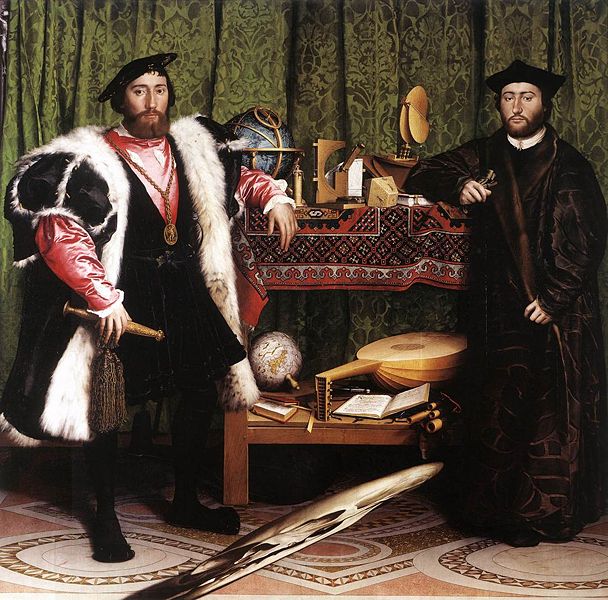
The Ambassadors by Hans Holbein the Younger, 1533

How does art mirrors society?

The Ambassadors is a painting made in 1533 by Hans Holbein the Younger. This particular painting was painted using oil on canvas. The painting itself embodies all of the elements that defines the Renaissance. This element of change that was happening in the Renaissance was captured through the painting. This element reinforced the Renaissance in terms of art and secular knowledge such as of exploring the world. The art technique that was exploited in this painting uncovers the progress of art in the Renaissance. Perspective was a technique that was only formally introduced in the Renaissance. This was a technique to represent volume and spatial relationship to a flat surface. The use of foreground was important to the artist as it direct the viewer’s attention to the prominent part of the painting that the artist wants to show. In this case, the foreground was the two ambassadors as they were painted bigger in shape. Sfumato and Chiaroscuro were created by Renaissance artists to add gradation of tone, color, light and shade which creates a more realistic painting. This can be seen from the painting above by the curtains, clothes, etc. Holbein uses symbols to show the secular knowledge of exploration in the Renaissance. People of the Renaissance started to explore the world and therefore started to create and used scientific instruments to guide them. The scientific instruments that were used were shown in the painting. There are two globes and other instruments that contribute to the Renaissance’s progress towards exploring. The advancement of technology and the art of exploring were represented in the painting that greatly expressed how the Italian Renaissance evolved. Change filled the atmosphere of life during the Renaissance. Change not only in terms of art and exploration but other aspect such as trading and banking. This driving force flourished due to people taking an interest of exploring the outside world. Since people began exploring foreign lands, they started to inquire ideas and traded with people from the foreign lands. These ideas circulate and spread in Italy which leads to further advancement of Italy. Each aspects and elements within this art described the occasions of change in the Renaissance which we can recognize how this advancement of the Renaissance was further developed into what we know today.

Tuesday, September 28, 2010

Driving Forces of the Renaissance.


Raphael Santi, The School of Athens Stanza della Segnatura, Palazzi Vaticani, Rome

"Which one driving force do you think was the most crucial in creating the Renaissance's explosion of ideas? Why?"
I believe that the 'rediscovery of ancient knowledge' was the most crucial driving force in creating the Renaissance's explosion of ideas due to the fact that without the knowledge of the past, the Italians wouldn't be able to make progress. Since the Roman Empire and the Middle Ages collapsed, some knowledge that was left behind such as of the human body, architecture, astronomy, literature, birth and more was rediscovered, studied and improved. The Italians was able to make progress and therefore it advances Italy. They also gained better understanding of the world around them as a result of the rediscovery of ancient knowledge.


Sunday, May 30, 2010

C'est La Vie

I’m thirteen. I am no different from any thirteen year old girl. I crave for what I don’t have and everything I say or act has a meaning that goes along with it. I often get lectured and scolded from my parents for being me. The ordinary things like sleeping too late, having a messy room, horrible marks and the list goes on because you just don’t make 3 mistakes. You make countless reckless ones just because you’re thirteen, in my case that is. As I lay on the edge of my bed, arms clasped and tears rolled down my cheeks, I curled up just like when I’m in my mom’s belly. My eyes glued so tight that everything would fail to open them. I closed my eyes so tight wishing I wouldn't have done what I did. But life just doesn’t work that way. My parents were upset and fed up with my attitude. They felt that I was acting like a snob to them. This stabbed me. And When you get stabbed, it will always remain in you and you will always remember. The stinging pain lingers in my body and I can’t get it out. That night stretched long and endless and I could still taste its bitter sweetness.

Parents have a lot of worries and one thing they worry is you because their love for you is stronger than the strongest person ever lived. They want you to succeed in everything you do and made sure you’re not going to make the biggest regret. They’re your safe harbor whenever you need help and protection. But that night lead me to a different perspective of them. That night made me realized how unfair they were and how they claimed they’re always right. How can they be
my parents?

As the night faded slowly and painfully, so did my pain. After all the anger washed out of my body, I went back and peeked in what I had done in the past. I saw how I acted towards my parents and the guilt came creeping in. I regret what I denied to my parents and I craved to say my sorry. But my mouth wouldn’t let me. Instead I wrote it on my wall “I’m sorry, it’s hard to say it so I wrote it”. I believe that everything in life has a cost. Everyone has to pay the cost, in my case I had to handle the truth and accept what my parents see because you can’t see how you act but other people can. If a situation like this came again, I would manage it the right way and say “
C’est La Vie”.

Sunday, May 2, 2010

The Battle Of Hastings 1066


The Battle Of Hastings 1066
This is a game that is designed to be the reenactment of The Battle Of Hastings 1066 by BBC. It is a strategic game meaning there's "Important or essential in relation to a plan of action" (1). To begin playing this game, you have to choose between King Harold Godwinson, Earl of Wessex or Duke William of Normandy. The game would start on different point of view depending of whom you chose. Basically this game goes through a series of two questions and each one contains different strategy which means by choosing one or the other, would lead to a different set of questions. I like the fact that this game is based on strategies and since I did learned about this battle, it really helps on picking what strategies to pick which makes the game easier. I learned that having strategies helps a lot in the real Battle of Hastings that happened in 1066 and also in winning this game. The strategies that Harold used was that he placed his soldiers and army on a hill making it difficult for William and his army to attack since they had to charge uphill to get them. Another one of Harold's strategies was having a 'shield wall'. This shield wall was so powerful that even when William's archers fired lots of arrows at them, it didn't harm the shield wall and still stood strong. The last strategy was having housecarls, the best mens, to be at the front that leads the army. Duke William's strategies were having large number of knights, having series attacks and trick retreats. William had a good number of knights that would surely helped but then Harold and his army was uphill which makes it hard for William to attack. Even though Harold and his army had a strong 'shield wall', it eventually break off by William's series attacks and trick retreats. In the end William's strategies of having series attacks and trick retreats beat Harold's strategies. Therefore William had won the Battle of Hastings and would be King of England. This is a valuable learning experience because it is a learning based game about the history of the Battle of Hastings in 1066 which means not only you get to learn the strategies of a battle during the middle ages but also learning some parts of what happened in 1066, England.

Source 1- www.dictionary.com


Thursday, April 15, 2010

'Catherine Called Birdy' by Karen Cushman.

One historical fiction novel, ‘Catherine Called Birdy’ by Karen Cushman, explores a knight’s daughter who battled through gender equality, powerlessness, ambitions and family restrictions, problems that is set in Medieval Times. Catherine or also called Little Bird, endured problems like gender equality that is mostly one of the main struggles in medieval time. “Instead I thought to make a list of all the things girls are not allowed to do: Go on crusades, be horse trainers, be monks, laugh very loud, wear breeches, drink in ale houses, cut their hair, piss in the fire to make it hiss, wear nothing, be alone..” -pg 66, this quote shows that Catherine wrote about having no justice and equality as a girl. This was written in many parts of the book, to emphasize the lack of gender equality during medieval times. “I have noticed lately how many male saints were bishops, popes, missionaries, great scholars and teachers while female saints get to be saints mostly by being someone’s mother...” –pg 144, This quote reveals the fact that even in religion there was a lack of gender equality. Catherine must also abide the fact that since there’s gender equality, then there must be the powerlessness for just being a woman. In medieval times there was also a caste system, which is a system of where people belong in different levels in society and where Catherine’s family is at the middle of the caste. One main problems of being a woman, in the middle caste system, is that the father arranges who the woman should marry with. “I must make a plan for I will not, of course, wed the pig…”-98, this quote shows that Catherine would always avoid being paired up with no choices or so. “I am left with a beastly father, a life of chores, no hope, no friends; no escape…is there justice in the world.” -pg 22, this quote explains how Catherine is complaining about the lack of freedom and power to do what she wants. Ambitions and Family Restrictions were also a problem that was faced by Catherine during medieval times. “Why must I learnt to walk with a lady’s…” and “…travel with them and have and experience. Mayhap…never return to old spinning and sewing manor.” These quotes represent Catherine’s family restrictions that she has to spin and sew and be a proper lady. “How I would rather go crusading like Uncle George or live with...” -pg 13 and “My mother gave me a gentle but stern lecture about behaving like a lady.”-pg 54, these quotes explains of Catherine’s ambition to go crusading rather than having to sew and spin, the second quote explains of how she always have to be taught how to be a well-mannered lady. Long ago, life in medieval time was extremely frustrating especially for a knight’s daughter that battled these challenges like gender equality, powerlessness, ambitions and family restrictions. The facts that Catherine is human and since humans grow and learn from their past mistakes, made her open her eyes and accepts her environment.

Sunday, March 7, 2010

Answers to the Webquest.

1. Which country did Germany invaded first?
Germany invaded Poland in September 1, 1939.

2. Why did Hitler and Stalin able to share the Poland at first?
They were able to share Poland at first because of the non

aggression pact.


3. When was the exact day when World War 2 was started?
The exact day when World War 2 started was September 1, 1939.

4. Was Hitler successful invading France?
Hitler was indeed successful invading plans with his smart leadership and plans.

5. How did Hitler led Germany to become the strongest country?
Hitler led Germany by rebuilding the German military and going against the treaty of Versailles. He built a new airforce, tanks, submarines and ships. Basically, Hitler try to regain Germany back into power and scheming his way to greater power that led the Germany to become the strongest country during World War 2.

6. Was Switzerland able to survive in World War 2?

Since Switzerland did not participate in World War 2, it did survive.

7. Did Soviet hated the Jews?

The Soviets did not hate the Jews although it allied with Germany.

8. Is the former Germany the same size of the modern Germany?
Germany invaded and conquered other countries in Europe and so the size of it must have changed. But the Soviets fought back and so did other countries, this resulted that the size of Germany changed again.

9. Why did Hitler told the Germans that Arians are the most superior race?
I couldn’t find this answer.

10. Give two reasons that Hitler hated the Soviets..
I couldn’t find this answer too.

Thursday, February 4, 2010

Webquest, Questions, Holocaust.

Begin the web quest by opening this website: http://www.ushmm.org/education/forstudents/

Click on Introduction to the Holocaust and start reading on this article.

1. Explain what the holocaust is.
The Germans decides who’s in and who’s out. Why did they decide this? Who were in and who were out? What happens to those who are out?
2. Read paragraph 3 and 4. What were the Nazis plan to take out the Jewish population?
3. What happens in the aftermath?

Click on antisemitism and read this article.

4. Explain the term ‘propaganda’ and ‘genocide’.
5. The Nazi party that was led by Adolf Hitler gained popularity for their theories of racism? How did they do it?
6. In the illustration drawn by anti-Semitic children, why were the people (Jewish) drawn strangely and looked dumb while the people that past the post, were looking lively and rich?
7. “Millions bought Hitler's book Mein Kampf (My Struggle), which called for the removal of Jews from Germany.”
What does this text from paragraph 4, says?

Next go to "Jewish life in Europe before the Holocaust"

8. Before the Holocaust happen, Europe is a vastly wide populated with Jewish people and culture. Why would the Nazis want to take the Jewish population and cultures away?

Go to
"Nazi rise to power"

9. Read the article and explain how Hitler came into power. Was this the start of Hitler’s power?
10. Hitler was obviously a smart leader. How did he manipulate the public’s minds and brainwashed them into thinking that eliminating the Jews was a “good” idea?

Thursday, January 28, 2010

Band Blog Post.

Part Onee.

ISKL misson statement: The International School of Kuala Lumpur provides an exceptional education that [SILENCE] challenges each student to develop the attitudes,
skills, knowledge and understanding to become a highly successful, spirited,
socially responsible global citizen.
In this ISKL mission statement, adding the silence after "that" creates the tension and curiosity. When a reader reads this out-loud to a bunch of people, the effect of the silence adds the tension and curiosity. The people would start to ask questions to what the reader is about to say next and what is the ISKL mission statement is. The curiosity in this would come from the people asking the questions. The tension would be from the atmosphere that forms when the reader uses the silence.
Part Two.
Composers can create tension in their music by using an unexpected silence (void). Also by taking elements of music to create the silence. When composers takes away elements of music and add silence (void), this makes people start to ask questions. The release is when the composer gives back the elements of music that was taken away and stops the silence. This would give the people the answer and the release they needed.

The Black Spot

The Power of the Void- Band Assignment
I would call the title of the story “The Black Spot”. It gives an insight to the story and it creates tension and questions on people’s minds. This is like the beginning of the suspense and tension as well as the start to the story. “Bill Hutchinson went over to his wife and forced the slip of paper out of her hand. It had a black spot on it, the black spot…” this quote from the text is when the Hutchinson family opened up their papers to see if any of them has the black dot on their papers. I taste that everyone of the villagers was curious of who got the black spot; this was the moment when the intensity of the villagers was high. But after the villagers found out that Tessie got the black spot, a release occurred. There was no more suspense or curiosity and it turned into a relief. When I found out the end of the story was not given, questions starts to twirl in my head. Questions to what the ending could be. The mystery paper made me curious but since there was no ending to the story, I predicted that the mystery paper holds the ending. “Do not open until 5p.m and follow the instructions” I did not open the mystery paper at 5 because of the curiosity that makes me open it afterschool. By writing this, I am following the instructions on the mystery paper.

THE BLACK BOX. THE BLACK SPOT. THE BLANK PAPER.

The black box is the key to the ritual/lottery. This ritual or “lottery” is done every year by Mr. Graves and Mr. Summers. They made the papers and placed a black dot, then stuffed them in the black box. Whoever receives the paper with the black spot will receive the consequences.
The black ‘deadly’ spot sits on a paper and the unlucky villager that takes this paper will receive consequences. That unlucky villager happens to be Tessie Hutchinson. As a result of this, the villagers threw stones at her. This was the ritual/lottery that takes place every year as a tradition to this village.
The blank paper shows the other villagers luck of receiving a blank paper instead of the paper with the black spot. I predicted that nothing happens to those villagers and that they are safe.


After reading the ending to the story, there was still some tension and curiosity because the ending still seems mysterious and left unexplained. Instead of having the release of tension and curiosity, the author ends the story unexplained. My predictions were somewhat correct and somewhat wrong. 50-50. I feel the need to re-read parts of the story to get the mood of the story and try predicting something with that. Knowing other information’s about the story would have helped me make better predictions. Leaving voids in the story and exaggerating it makes the story mysterious and readers would ask more questions because of the unexplained voids. No title or author leaves the reader wondering more of what the author did to the story. His or her flavors and writing choices is unknown which gives the readers no information on what the author’s impact on the story. No ending cause a greater tension and curiosity as people are predicting that they would know the whole story. Text clues and foreshadowing gives excellent small voids that add up to the whole void of the story. The mystery paper that contains the ending made the final touches to this whole void assignment.

Sunday, January 24, 2010

"A good picture makes us curious and makes us want to know more”

“If we look at the photographers whose work we admire, we see that they’ve found a particular place, theme, or subject, dug deep into it, and carved out something that’s become special. That takes a lot of time and a lot of work; it’s not for everyone. A great photograph really needs to say something about a person or give some insight into their life or how their life is different than yours and mine. A good picture makes us curious and makes us want to know more.” -Steve McCurry,

Steve McCurry is a photographer regignized worldwide from Philadelphia. He kick started his career in photography while working for a newspaper, then moved on to freelancing. Not only is McCurry a freelancing photographer, but a traveler as well. India was the country that touched McCurry’s heart. "If you wait," he realized, "people will forget your camera and the soul will drift up into view."- Steve McCurry. McCurry’s photos are famous for having connections with the chosen subjects and the people viewing the photos. Through his photos, I could see that McCurry has a passion of capturing the human nature as well as having connections. Human nature like the struggles, pain, joy and more that would appear in his photos. The connection of his subject’s eyes attracts people’s attention to look deep within the surface. A good example of this is the photo of the green-eyed Afghan Girl that stood out from all of his photos, and most likely one of the causes of his great success. What makes this photo so breath taking is the simplicity of the image. There isnt much of an expression on her face, so the viewer's attention is automatically drawn to her eyes.


On the photo:
Steve McCurry
shoots such abrupt photos that leave viewers hanging around to dig into the meaning of the photos. When you first look at photo that there’s a young boy, holding a gun that is pointing at him. This would be the surface of this photo but there are lots of hidden things that I have to dig in order to read what’s hidden. The young boy’s face is the first step to find what’s hidden. Tears pouring out of the young boy’s eyes made me feel the need to comfort him and rub his tears away. The tears and the crying, for me, symbolize a lost hope. The gun in his hand captures my eyes and it is the second step towards finding the hidden meaning. This made me think that the young boy is having a hard time and this photo capture the moment when he’s about to give up on life. The gun symbolizes of losing faith. The young boy in this photo symbolize of all human beings (humanity). All these three things, the gun, tears and the young boy add up and equals to the bigger picture. The bigger picture is that all human beings (the young boy) have moments when their eyes would be pouring out with tears and a gun would stand along beside them. This type of moments is when human beings lose hope and faith in their lives and that the gun is the key to end the painful moment. I think McCurry wants people to look at this photo so that when this type of moments comes along, they shouldn’t lose their hope and faith. And that people should continue on their life rather than ending it and having regrets. After all we as human beings have one life to live.

Understanding McCurry’s works; travels, photography and personal life gives me an insight of digging beneath the surface to find the other side of life that hasn’t been noticed or touched. His photography made me connect with that other side of life of people whom I have never noticed. I learned that his photos make people around the world connect with each other and learn to understand of the difference and similarities with people living in different cultures. From learning this, I gained an understanding of how a great photograph tells a story of the people living in different cultures. It’s difficult to find that story as it is hidden beneath the photo. That is what a great photograph should be; digging up the surface to find the hidden meaning/story. A great photograph also attracts people’s curiosity to look for that too. These are some of the factors that makes great photos endure and last for decades.

Saturday, November 21, 2009

Jason and The Argonauts


Many heroes from Ancient Greece fits well with the ‘cycle of the hero’ as developed by Joseph Campbell. The aspects of the cycle show the elements of the journey that the heroes embark on. Jason and the Golden Fleece matched the cycle of the hero and these are the evidences;

Birth/Home: Jason was formerly born from a royal family as his dad was the rightful king of Iolcus. His malicious uncle, Pelias stole his father’s throne and claimed himself King. Pelias would have killed Jason when he was a baby but Jason’s mother saved him and sent him to live with Chiron, the Centaur. There Jason learnt to fight and hunt.

Call to Adventure: Jason grew to be a strong and brave man from Chiron care. When he learned of his past, he decided to go up to his uncle, King Pelias and demands back his rightful throne. King Pelias decided that Jason journey to find the Golden Fleece and only then he would give his throne back to Jason. This was the start of the adventure/journey.

Elixir: The elixir of Jason’s journey was the Golden Fleece. He had to find the Golden Fleece in order to retrieve his rightful kingdom. The whole myth and journey was finding the Golden Fleece and this is what kept him alive.

Helpers: After Jason received the challenge, he searched for other heroes to accompany him as he embarks on the journey. Many heroes were ready to risk their lives but Jason had chosen his crew, they were called ‘the Argonauts’. And so they set off in search of the Golden Fleece.

Helpers/ Amulet: In the videos, not only the Argonauts were the helpers but Chiron, the Centaur also contributes to Jason’s journey. Chiron had brought up Jason and teaches him to fight and hunt. As a result Jason relies on Chiron to make his decisions and to encourage him when he gets stuck during the journey. Chiron’s sword was the ‘amulet’ of Jason’s adventure and it was a lesson for Jason to trust himself and not rely on black magic.

Crossing the Threshold: When heroes embark on a journey, there would always be obstacles that stand in their way. The same goes for Jason and the Argonauts, they had to sail the ocean and had to search for the kingdom of King Aeetes. Crossing the ocean is difficult because there would be storms and unpredicted weather. In the videos, it shows that the waves were pulling Jason’s ship to the ocean. Also the clashing rocks from one interpretation of the myth were one of the obstacles.

Tests: Jason and the Argonauts had series of tests that keeps on coming. Not only was sailing the ocean was hard enough but there was many conflicts such as Jason versus himself. Jason didn’t trust and believe in himself instead he trust the potion which was given by the malevolent sorcerer, Medea . As a result, his crew was taken by Medea and was going to put them in the underworld. There was also the fight against the fire breathing bulls and the dragons that guarded the Golden Fleece. Every time the Argonauts faced and deal with these obstacles, they gained knowledge to complete the journey.

Climax/final battle: In the videos, the final battle was against Medea while Jason had to save the Argonauts from going in the underworld. He believed in himself and trust in Chiron’s sword, as a result he won the battle and Medea was perished. And because medea was perished, the Argonauts was saved.

The Return: After Jason defeated Medea and retrieves the Golden Fleece, he and the Argonauts sailed back to Iolcus and take back the rightful throne.

The characters in the videos and the characters in the myth are quite different in some parts and alike in others. The difference was the character “Medea”. In the videos, Medea was shown as the malicious sorcerer that provides as an obstacle to Jason’s journey. In the myth Aphrodite, the goddess, made Medea fell in love with Jason. As a result Medea helped Jason to retrieve the Golden Fleece and in return Jason had to love and honor Medea. I think that Jason was weak in both the videos and the myth. From what I see in the videos, without the Argonauts and Chiron, Jason couldn’t complete the journey. Also it seems like Jason was only the leader of the Argonauts that ask them to do things for him. Although in my opinion that Jason was the weak one, I could see the change after he completed the journey. During the journey, Jason asked Chiron for help and made the wrong decision in to trust the potion, Medea gave him. Jason didn’t believe or trust himself that he could do it without the black magic but after he completes the journey, he learnt to trust in himself that he could do it. There’s many interpretation of the myth Jason and the Argonauts or they’re sometimes called Jason and the Golden Fleece. But which myths interpretations are right? Well people don’t know which one is right since the people who wrote down the myths were told by the storytellers who change the stories to make it more interesting and juicy.

What events in the story of Jason and the Argonauts do you believe to be factual?
There are many events in the story of Jason and the Argonauts that was believed to be factual. The geographical setting of the myths could be real. One of the geographical places like Mt.Pillion from the myth is in Greece. The palace of Iolcus was found in Greece in which Jason went to the King to retrieve his royal throne from his uncle. The caves and islands was real, this adds more evidence that the myth could have possibly occurred. From the myths, one of the obstacles was the rock clashing. It could be possible that it was just the harsh waves with rocks that made Jason and the Argonauts struggled. I think that the storytellers was changing the story to make it juicy, because in the myths, it was told that the rocks crushed boats that passed by. But in real life rocks don’t move yet crushed boats but as I said it could be possible that it was just harsh waves and rocks. In the movies that we watch in humanities, the people in Greece was building the ‘Argo’. The ‘Argo’ was a type of boat that Jason and the Argonauts sailed in search of the Golden Fleece. This means that the boat could have been used to sail. There’s maybe more evidence of this myth to be true, like the Trojan War, Jason and the Argonauts could have actually occurred.

Tuesday, September 29, 2009

Orphan Boy and Pandora's Paragraph


Curiosity, a main theme from an African and Greek myth, Orphan Boy and Pandora, demonstrating that the result of people’s curiosity often cause changes, sometimes good and bad. In orphan Boy, the old man’s curiosity took control of him and it affect his decision to follow and look when the orphan boy did his magic. As a result of this he lose the orphan boy, his only friend and family. This leads to a change to the world, it receive punishment and the old man was lonely again. Pandora’s curiosity to open the box from Zeus, who seeks vengeance on human and Prometheus by using Pandora, unleash evil on earth. This antecedent changes humanity, now poverty, illness and famine spreads on earth. Although one good thing came out, Hope, humans only salvation. Both of these myths shows bad changes, which made me think "did people back then was warning us the danger curiosity can holds?". It's true that we can't see the results of our action and path that we chose, nor our future.
1st picture-
artist: ?
I chose this picture because of the foreshadowing details. For example the box has green fouling inside it, which is the evil that is kept inside.
3rd picture-
I chose this picture because it represents Pandora's curiousity. In the picture, she is bending over and was beginning to open the box. I like how the artist chose the color and the lighting. Although evil was supposed to come out of the box, this was the last one that came out, hope.

Wednesday, September 16, 2009

ahh maa lee aa


Seasons change and so does my hatred and love for my name. I have my bright months and cold months. Spring and summer, a time when the sun hangs in the sky, creating a warm aura that warms the heart. Winter, a cold month, harsh and dangerous in some places. My name also seems like a wide ocean. It would take days and weeks to swim across, just to pronounce and remember my name right.
I have never think about what my name means or where it comes from. Until I was nine when my brain automatically change from a 2nd grade mind to a nine year old mind. Why did my parents named me that? What does it means? questions starts to flow around and around. The questions ran around my brain, thirsty for an answer. I couldn't give the answers they seek because I didn't know it either. My mind was jammed with questions, I thought they would disappear and that I would move on but the curiosity was planted in my brain. I gave up with a sigh and decide to ask my mom. Finally, poof! the questions and curiosity was no longer lying around in my brain. The answer was that my name, Amalia, comes from an Arabic word, 'Amal' meaning generous. Also it comes along with a tiny description that says I like doing good deeds. I begun to like my name :)
Winter comes along carrying the cold and frigid sky that changed the atmosphere. On one normal school day, a boy in one of my classes started calling me 'Malaria'. Amalia, Malaria,, I guess they do rhyme which maybe was the reason he found that name. I don't know the real reasons why he started calling me that, I wish I have the power to read minds, hehe. I don't like being called a disease, would you want to be called a disease? if yes, there is something wrong with you (just kidding but seriously?). The sound of it is like an injured animal, screeching for help. That's what it sounds like when it pass my mind. The point is that now his friends starts calling me 'Malaria' too. I guess my plan now is to ignore it, someday they're going to get bored of it and stop (or not).
Spring overtook winter, changing the chilly atmosphere into the warm feeling that we recognize. This time of the seasons is where it seems that I appreciate my name. My name is quite unique in it's own ways. Outside of my name lies my personalities while deep inside held my true feelings. I like the meaning behind my name but somehow when I searched my name meaning, the website shows me that their meaning and the meaning that my mom told me was different. My name came up lots of times, I found out that I have 12 origins. From Hebrew to Latin, most of them had similar meanings like hardworking and striving. I guess I like these meanings but work? labour? indrustrious? how does that fit me, did my mom wants me to work? puzzled and shocked, I started to think. Hmmm... I think that maybe just maybe my mom did want me to work but not to overwork. But I also think that when my parent's was deciding to name me, they were thinking of the arabic names. Hopes, aspirations and wishes, when I think about that, I feel lucky that my parent's decide to name me, Amalia.